Arizona · District 8
U.S. House, District 8
Incumbent on the ballot
Forecast locked November 3, 2026, 5:40 p.m. Eastern, before polls closed and before any return was read. Every share and vote figure on this page is that forecast, added up from the counties and county pieces inside the district below. Not a poll average, not ballots cast, and not an official result.
In the forecast
71st-closest House race in the forecast, 8.8 points, out of 435.
The forecast is 221 Democratic and 214 Republican House seats. A majority is 218.
Changing only this seat would not change which party has a majority. The Democratic majority has 3 seats to spare.
No earlier forecast of this race is archived.
History block in the model: R+13.0. That is the office blend, not one past election.
Last same-office result in the candidate file: 2024 R+13.0. The district number is that year’s number.
The polling block for this race was omitted.
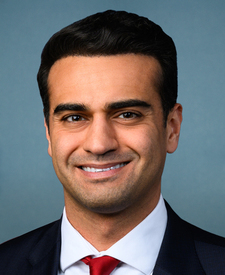 RAbraham Hamadeh, R
Abraham Hamadeh
Republican · Incumbent
Bernadette Greene-Placentia
Democratic
Margin
R+8.8
Win probability
85.6%
80% interval
D+1.9 to R+19.4
95% interval
D+7.6 to R+25.0
Raw data Checking polls.
No live poll enters this race, so the band is the wider fundamentals interval from 50,000 draws. The thin mark is the 95% interval. The thick mark is the 80%. The hairline is zero. 263,457 projected votes, equal to the table.
District
Projected vote by county, inside this district only.
Drawing the counties in this district.
Counties and county pieces inside the district
Only the counties or county pieces inside this district. The projected votes above are this table added up.
| Party | |||||
|---|---|---|---|---|---|
| Maricopa County · part | RAbraham Hamadeh, RAbraham Hamadeh | R | R+8.8 | 54.4% | 263,457 |
Model
- Raw data
2024 presidential baseline
National R−D 1.5County presidential file. Not the 2026 result.
- Raw data
Generic ballot
D 51.7 R 43.1 R−D -8.6National Wikipedia aggregate, 2026-10-30. State generic ballots, where a public poll exists, are mixed with the national swing for a race that does not have its own poll: ME, MI, NH, NY, OH. A state with no generic-ballot poll keeps the national swing and is not assigned a neighbor's.
- Raw data
Party identification
Pew D+5 and Gallup D+10, blend R−D -7.3Pew NPORS 2026, identifiers plus leaners: Republican 43, Democratic 48. Gallup party identification plus leaners, first two quarters of 2026: Democratic 49, Republican 39. Pew is 55% of this blend and Gallup is 45%.
- Model input
National block
R−D -8.160% generic ballot and 40% party identification. The swing versus the 2024 presidential margin is what gets transmitted.
- Model input
Swing transmitted
0.79 × -10.1 = -8.0No state generic-ballot poll. The generic ballot is R−D -8.6, a swing of -10.1 from the 2024 presidential margin. A race without its own poll uses that swing, not the 60/40 block. This state is not given another state's number.
- Model input
History block
R−D 13.02024 House result on these lines, R−D 13.0, weighed in full for this district. The presidential vote inside the district was R−D 17.5. That margin is the baseline. It is not added again as favorability or as a second overperformance. Rural counties are weighted by the votes they cast, not equally. Every county in this district is split. The whole-county average was R−D 3.5. A split county is not the piece inside the district, so those pieces follow the Cook PVI (R+8). That index is a share, not a margin, so the margin is R−D 17.5. A county that sits entirely inside the district is not moved by this.
- Model input
Electorate block
R−D 13.0Not a House weight. House turnout is not a separate block. Counties still move by ballot size when the result is spread back.
- Model input
Turnout block
R−D 13.0Not a House weight.
- Model input
National environment
R−D 5.0The same number as the statewide environment: the baseline plus the full swing shown above. House does not also apply a 45 percent copy.
- Model input
State environment
R−D 5.0Not a House weight. It matches the statewide environment and is not added a second time. It is not 45 percent of the swing.
- Model input
State partisan lean
R−D 17.5The 2024 presidential margin of this state, or of this district for a House race. It is heavier than the old state-environment block and is not shrunk toward the polling term.
- Model input
Trump popularity
R−D -7.4New York Times approval average, October 29, 2026: 37.4% approve, 60.2% disapprove. Net approval -22.800000000000004. That is not a vote share. Four-tenths of the net is a margin, then scaled by this place's partisan lean (factor 0.82), so an unpopular president costs more in a Democratic state.
- Model input
Candidate favorability
R−D 0.0This member's last margin is already the baseline, so it is not added again as favorability.
- Model input
Demographics
R−D 13.0Not a House weight. College, rural, and nonwhite shares are not applied to a district. This line is the baseline.
- Model input
Finance
R−D 13.0Fundraising in the House weights has no separate spending score, so this block is the baseline.
- Model input
Issues
R−D 13.0No sourced issue score. Same treatment as finance. It is not a separate issue model.
- Model input
Polling
OmittedNo public likely-voter poll of this district. A statewide Senate or governor poll is not a district poll. No state generic-ballot poll. The generic ballot is R−D -8.6, a swing of -10.1 from the 2024 presidential margin. A race without its own poll uses that swing, not the 60/40 block. This state is not given another state's number. No district poll, so there is no undecided line to allocate. Banned individual rows excluded: 0. No same-office polling miss was sourced, so none is added. Applied to the polling term: 0.00. Public pollsters: 0. Outliers: 0. Recency half-life 16 days. Sample weight n/(n+350). A registered-voter poll is 0.90. An internal poll, or a poll sponsored by one party, is weighted 0. It is not in the average. An internal-only file is dropped. A poll that names both parties is not an internal. A poll more than 8 points from the median of the others is cut in half. Pollster quality nudges that weight by only a few percent. The same rule is used on a House poll. House district polls are likely-voter polls only.
- Model input
Generic ballot weight
R−D 5.0This race has no independent poll, so the generic ballot is already the environment swing. It is not added a second time.
- Model input
Top line
D+3.5 added wholeGovernor R−D -6.8. The district was R−D 12.4 before this. Eighteen percent of the gap to the statewide ticket is kept, capped at 4, so D+3.5. House is federal, so it does not take the statewide margin whole.
- Model input
Candidate
R+1.00 added wholeAbraham Hamadeh won the seat in 2024 and gets 1.0 candidate-quality point. A primary opponent is not used. These points are not watered down to the candidate weight. The candidate weight is a separate slice of the baseline. On a Senate or governor race with three public polls and no outlier, the points stop at that poll instead of moving past it.
- Model input
Scandal
NoneNo candidate on this ballot is scandal-defined.
- Model input
Endorsements
R−D +0.26Trump endorsed Abraham Hamadeh. The presidential lean here is R−D 17.5, so the endorsement helps 0.26. Ballotpedia, Endorsements by Donald Trump, 2026 tables, page updated August 5, 2026. A primary endorsement is counted when that person is the nominee. A lost primary, a candidate not on the ballot, and a withdrawn endorsement are not.
- Model input
Halfway floor
AppliedPresidential vote on these lines was 17.5. The result may not move more than halfway from that toward the generic-ballot swing. Held at 12.4. A district carried by 10 or more stays on that side of the floor. The state's top-line race then moves this district D+3.5.
- Model input
Pooling
House polling is its own block, and only for a public likely-voter poll of the district.A statewide poll moves the district only by the district's elasticity. Partisan lean, Trump popularity, and favorability are separate terms.
- Model input
Prediction market
NoneNo Polymarket or Kalshi contract with at least $10,000 traded on this general-election pair. Primary markets are not used. The other weights are not scaled.
- Model input
State bend
R−D -1.2AZ is adjusted 1.2 points toward the Democrats after the blend, from 9.2 to 8.0. Florida takes less of a Democratic national swing. Iowa, Wisconsin, and Arizona are not left pinned to a red presidential lean when the race is close. A seat already 15 points the other way, or a House seat whose own lines are 6 points that way and the race is already 4 points that way, only moves 1.2.
- Model input
State environment adjustment
National onlyThis state already has its own environment adjustment after the blend. It is not given a second one.
- Model input
Other ratings
R−D 9.5 at 3.0%Cook, Sabato, Inside Elections, and the other columns on the same published tables (Decision Desk HQ, RealClearPolitics, Split Ticket, FiftyPlusOne, The Economist, Fox News, Silver Bulletin). 10 ratings, average R−D 9.5. A toss-up is 0, tilt 1.5, lean 3.5, likely 7, safe or solid 12. If this race is already further to that side, the rating does not pull it back. Mixed in after everything else, at 3.0 percent. It does not replace the poll. A seat nobody has rated is left alone.
- Model input
Weights
baseline 30.0% · overperformance 17.2% · statewide 12.8% · candidate 8.6% · fundraising 4.2% · stateLean 8.9% · trump 8.9% · favorability 6.5% · ratings 3.0%History is lighter. State partisan lean, Trump popularity, and candidate favorability are their own terms. A market, when it qualifies, scales every other weight and is not taken out of polling alone. Published ratings, when a race has them, are mixed in after that. They are not taken out of polling alone.
County-sum margin
8.8This is the House formula, summed from the pieces in the district. Elasticity changes which pieces move. It does not change the district total. The total includes the baseline, incumbent overperformance, the statewide environment, a district poll when one exists, candidate quality, fundraising, partisan lean, Trump popularity, favorability, and the halfway floor.
Minor parties
NoneNo third-party candidate is on this ballot, so Other is zero. A 2024 remainder is not assigned when nobody is there to receive it. An independent who is a main opponent stays named. No Libertarian, Green, Constitution, or other minor line was on this ballot.
80% interval
-1.9 to 19.410th to 90th percentile of 50,000 draws. Poll, national, state, turnout, and candidate error.
95% interval
-7.6 to 25.02.5th to 97.5th percentile. Senate and governor state errors in the same state share a correlation of 0.30. The band shown is the marginal interval.
Wikipedia, 2026 House elections in Arizona, citing the state election office apps.arizona.vote/electioninfo/Election/69